
Credit report clean up involves three main steps: pulling your credit reports from all three bureaus, identifying errors or negative items, and disputing inaccurate information through formal processes. Most people can complete a thorough credit report clean up in 30-60 days, though seeing results may take 60-90 days.
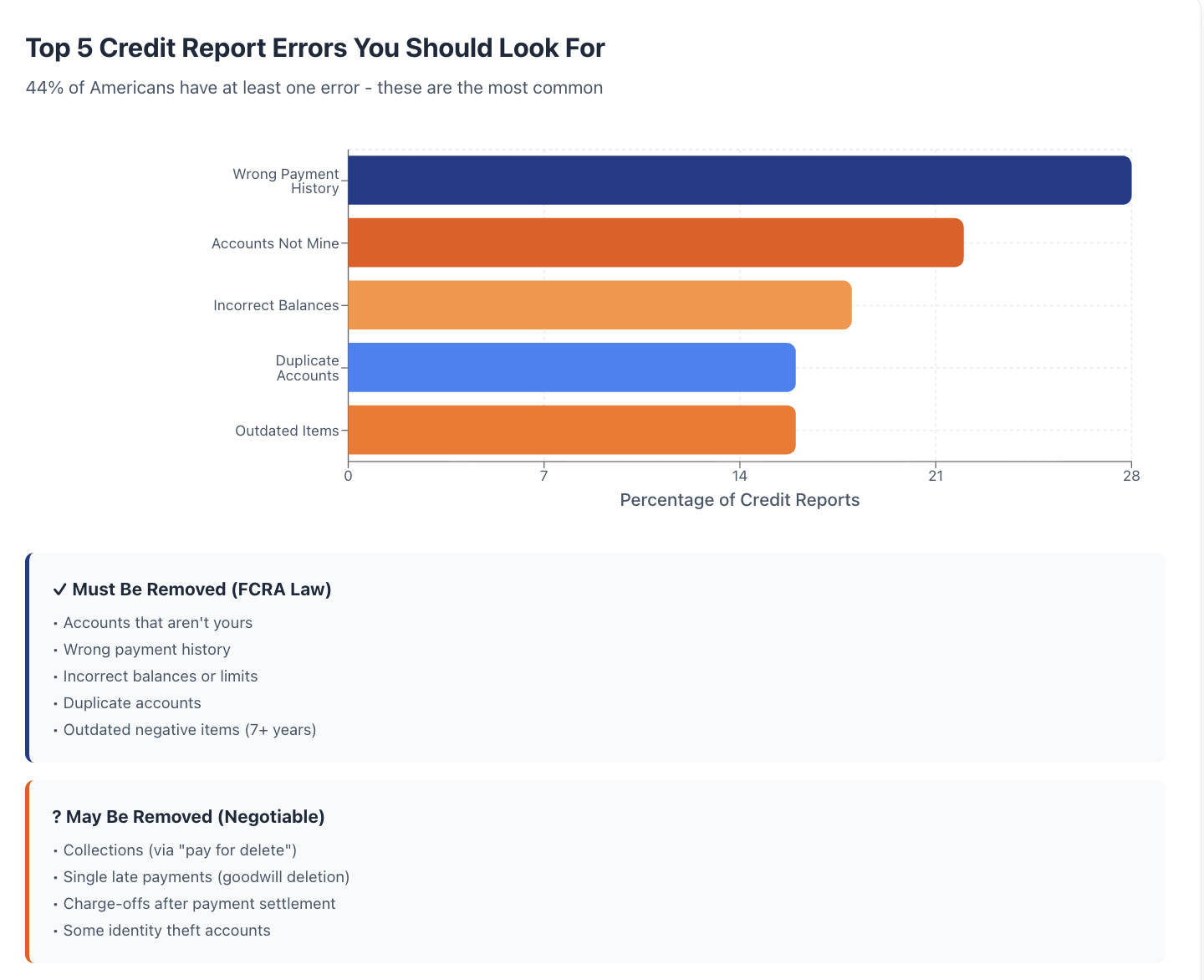
Imagine that 44% of Americans have at least one error on their credit reports, and these errors can cost you 20-100 points on your credit score. That translates to thousands of dollars in higher interest rates.
I'm writing this guide because credit report clean up is the fastest way to improve your credit score, if you do it correctly. Last week, a client increased her score 67 points in 45 days just by removing three errors from her credit report. She didn't pay down debt or open new accounts. She simply cleaned up inaccurate information that was dragging her score down.
Here's what you need to know about credit report clean up:
- Credit bureaus must investigate disputes within 30 days by law
- You can dispute errors for free, never pay for basic disputes
- Inaccurate information must be removed or corrected
- Accurate negative items can stay for 7-10 years (but may be negotiable)
- A thorough credit report clean up can boost scores 30-100+ points
Let me show you exactly how to do a complete credit report clean up, step by step.
What Credit Report Clean Up Actually Means
Credit report clean up is the process of reviewing your credit reports, identifying errors or problematic items, and taking action to remove or correct them. This includes disputing inaccuracies with credit bureaus and negotiating with creditors to remove or update negative information.
Credit report clean up fixes two types of issues:
Inaccurate Information (Must Be Removed)
These are errors that violate the Fair Credit Reporting Act (FCRA). Credit bureaus must remove them:
- Accounts that aren't yours (identity theft or mixed files)
- Wrong payment history (shows late when you paid on time)
- Incorrect balances or credit limits
- Duplicate accounts (same debt reported multiple times)
- Outdated negative items (past 7-10 year reporting limit)
- Wrong account status (shows open when closed)
Accurate But Negotiable Items (May Be Removed)
These items are technically correct but might be removed through negotiation:
- Collections accounts (via "pay for delete")
- Charge-offs (sometimes removable after payment)
- Single late payments (via goodwill deletion)
- Accounts from identity theft (with proper documentation)
What credit report clean up CANNOT do:
You cannot remove accurate, timely negative information just because you don't like it. If you legitimately missed payments and those payments are within the 7-year reporting window, they stay on your report. Credit bureaus are required by law to report accurate information.
Why Credit Report Clean Up Matters
Errors on your credit report directly impact your financial life in measurable ways.
The cost of credit report errors:
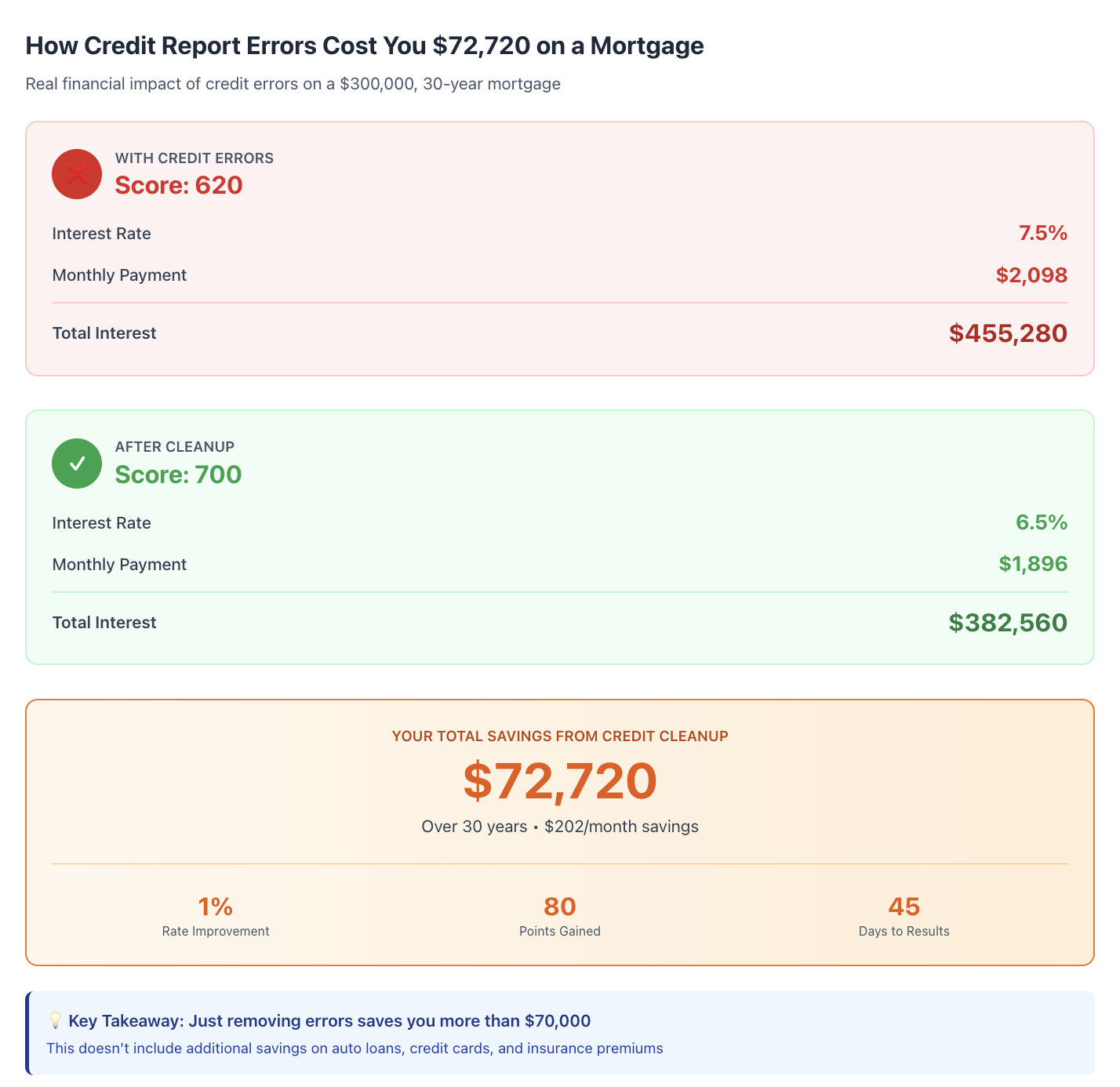
Let's say you're buying a $300,000 house with a 30-year mortgage. Your credit score determines your interest rate:
With credit errors (score: 620):
- Interest rate: 7.5%
- Monthly payment: $2,098
- Total interest paid: $455,280
After credit report clean up (score: 700):
- Interest rate: 6.5%
- Monthly payment: $1,896
- Total interest paid: $382,560
Savings from credit report clean up: $72,720 over 30 years (just from fixing errors), below is a visual representation:
Beyond mortgages, credit report clean up affects:
- Auto loan rates (can save $3,000-$8,000 over loan term)
- Credit card APRs (difference of 5-10% interest)
- Insurance premiums (poor credit costs $500-$1,000 more per year)
- Rental applications (many landlords reject scores under 620)
- Job applications (some employers check credit)
- Security deposits (utilities, apartments charge more for poor credit)
How To Do a Credit Report Clean Up
Step 1: Pull All Three Credit Reports
The foundation of any credit report clean up is knowing exactly what's on your reports. You need all three, Equifax, Experian, and TransUnion, because they often contain different information.
How to Get Free Credit Reports
Go to AnnualCreditReport.com, this is the ONLY official site authorized by federal law to provide free credit reports. Avoid imposters like "freecreditreport.com" or similar sites that charge fees.
You're entitled to:
- One free report from each bureau every 12 months
- Additional free reports if you're denied credit
- Free reports if you're unemployed or a victim of identity theft
Pro tip: Don't pull all three at once. Pull one every four months to monitor your credit year-round. For credit report clean up, though, pull all three now.
How to Read Your Credit Reports
Each credit report contains four main sections:
Personal Information:
- Name, addresses, Social Security number
- Date of birth, employers
- Check for: Wrong name, unfamiliar addresses (sign of identity theft)
Credit Accounts:
- All open and closed credit accounts
- Payment history, balances, and credit limits
- Check for: Accounts you don't recognize, wrong balances, incorrect payment history
Credit Inquiries:
- Hard inquiries (from credit applications)
- Soft inquiries (background checks, pre-approvals)
- Check for: Unauthorized hard inquiries
Public Records and Collections:
- Bankruptcies, tax liens, civil judgments
- Collection accounts
- Check for: Items that aren't yours, outdated items
Common Errors to Look For During Credit Report Clean Up
As you review each report, flag these specific errors:
Identity errors:
- Wrong name spelling or completely different name
- Wrong Social Security number (even one digit off)
- Wrong date of birth
- Addresses where you've never lived
- Employers you've never worked for
Account errors:
- Accounts you never opened
- Accounts showing as open when they're closed
- Closed accounts showing as open
- Wrong account balances
- Wrong credit limits
- Wrong payment history
Status errors:
- Late payments marked when you paid on time
- Accounts showing delinquent when current
- Charge-offs that were never charged off
- Collections that were already paid
Duplicate errors:
- Same debt reported by original creditor AND collection agency
- Same debt reported multiple times with different account numbers
- Same account listed on multiple credit reports with different information
Outdated information:
- Negative items older than 7 years (10 years for bankruptcy)
- Inquiries older than 2 years
- Accounts that should have been removed
Here's a visual:
Step 2: Document Every Error
Don't just notice errors, document them systematically. This documentation becomes critical when you file disputes.
Create Your Credit Report Clean Up Spreadsheet
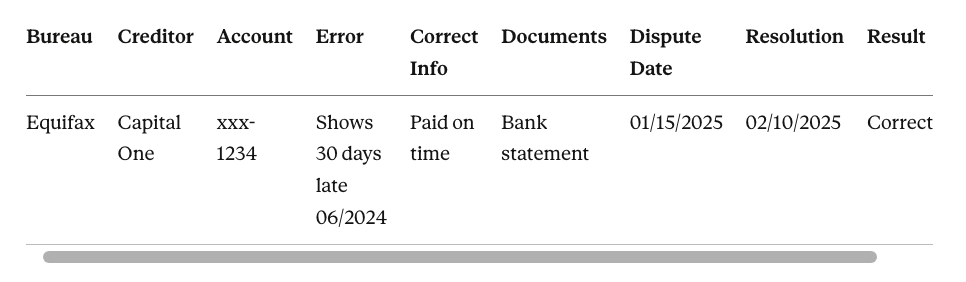
Set up a simple spreadsheet with these columns:
- Bureau (Equifax, Experian, TransUnion)
- Creditor Name
- Account Number
- Error Type (wrong balance, not mine, late payment, etc.)
- Correct Information
- Supporting Documents Available
- Dispute Filed Date
- Resolution Date
- Result
Example entry:
Gather Supporting Documents
For each error, collect documentation that proves the information is wrong:
For payment history errors:
- Bank statements showing on-time payments
- Canceled checks
- Payment confirmation emails
- Account statements from creditor
For account ownership disputes:
- Identity theft report (IdentityTheft.gov)
- Police report
- FTC Identity Theft Affidavit
- Documentation you were elsewhere when account opened
For balance/limit errors:
- Recent account statements
- Payoff letters
- Final billing statements
For duplicate accounts:
- Statements showing same debt on multiple entries
- Original creditor documentation
- Collection agency letters
Step 3: File Disputes With Credit Bureaus
This is the core of credit report clean up. The Fair Credit Reporting Act requires credit bureaus to investigate all consumer disputes.
How to Dispute Errors for Credit Report Clean Up
You have three options for filing disputes:
Online disputes (fastest):
- Equifax: equifax.com/personal/credit-report-services
- Experian: experian.com/disputes
- TransUnion: transunion.com/credit-disputes
Recommended Read: 5 Easy Steps To File an Effective Experian Dispute
By phone:
- Equifax: 866-349-5191
- Experian: 888-397-3742
- TransUnion: 800-916-8800
By mail (creates paper trail): Send certified mail with return receipt to:
- Equifax: P.O. Box 740256, Atlanta, GA 30374
- Experian: P.O. Box 4500, Allen, TX 75013
- TransUnion: P.O. Box 2000, Chester, PA 19016
For credit report clean up, I recommend mail disputes because:
- You have proof they received it
- You can include supporting documents
- You create a legal paper trail
- More weight in legal disputes
Good Read: What Is TransUnion Credit Score? Expert Guide to Credit Repair & Improvement
Writing an Effective Dispute Letter
Your credit report clean up dispute letter should include:
Your identifying information:
- Full name
- Current address
- Social Security number
- Date of birth
The error you're disputing:
- Creditor name
- Account number
- Specific error (be precise)
- Why it's wrong
- What the correct information should be
Your request:
- "I am requesting that this inaccurate information be investigated and removed from my credit report."
Supporting documents:
- Attach copies (never originals)
- List what you're including
Sample credit report clean up dispute letter:
[Your Name]
[Your Address]
[City, State, ZIP]
[Date]
Equifax Information Services LLC
P.O. Box 740256
Atlanta, GA 30374
Re: Dispute of Inaccurate Information
Dear Sir or Madam:
I am writing to dispute the following information in my credit report. The items I dispute are:
1. Capital One account #xxxx-1234 shows a 30-day late payment in June 2024. This is inaccurate. I paid this account on time, as evidenced by the enclosed bank statement showing payment cleared on June 5, 2024.
2. Collection account from ABC Collections for $1,500 is not mine. I have never had an account with the original creditor listed.
I am requesting that you investigate these items and remove the inaccurate information from my credit report.
Enclosed are copies of supporting documents. Please send me written confirmation of your investigation results and an updated credit report.
Sincerely,
[Your Signature]
[Your Name]
Enclosures: Bank statement showing on-time payment
What Happens After You File Your Credit Report Clean Up Dispute
The credit bureau has 30 days to investigate (45 days if you send additional information during investigation).
The investigation process:
- Bureau receives your dispute
- Bureau forwards dispute to the creditor who reported the information
- Creditor investigates and responds to bureau
- Bureau updates your report based on creditor's response
- Bureau sends you written results
Possible outcomes:
Dispute resolved in your favor:
- Inaccurate information removed or corrected
- You receive updated credit report
- Your credit score typically improves within 30 days
Dispute not resolved:
- Bureau determines information is accurate
- Information stays on your report
- You receive explanation of decision
No response from creditor:
- If creditor doesn't respond within 30 days, the item must be removed
- This is a common outcome in credit report clean up, many creditors don't respond to old items
Step 4: Dispute Directly With Creditors
For thorough credit report clean up, dispute errors with both credit bureaus AND the creditors who reported the information. This dual approach increases your success rate.
Why Dispute With Creditors During Credit Report Clean Up
Creditors (the original source of information) must also investigate disputes under FCRA. Sometimes creditors fix errors faster than credit bureaus, or they may remove items the bureau wouldn't.
Find the creditor's dispute address:
- Check your credit report (usually listed under the negative item)
- Call creditor's customer service
- Check creditor's website for dispute information
Sample Creditor Dispute Letter for Credit Report Clean Up
[Your Name]
[Your Address]
[Date]
[Creditor Name]
[Creditor Address]
Re: Dispute of Inaccurate Information Reported to Credit Bureaus
Dear Sir or Madam:
I am writing to dispute inaccurate information you are reporting to credit bureaus about my account.
Account: [Account Number]
Error: [Describe the error]
Correct Information: [What should be reported]
I have enclosed documentation supporting my dispute. Please investigate this matter and direct the credit reporting agencies to remove or correct this inaccurate information.
Under the Fair Credit Reporting Act, you are required to investigate disputes and report accurate information. Please send me written confirmation of your investigation and the corrections made.
Sincerely,
[Your Signature]
[Your Name]
Step 5: Address Accurate Negative Items
Not everything on your credit report is an error. You may have legitimate late payments, collections, or charge-offs. Credit report clean up can still help, through negotiation.
Goodwill Deletion for Late Payments
If you have one or two late payments on an otherwise perfect record, you can request goodwill deletion.
How it works:
- Write a letter to your creditor
- Acknowledge the late payment
- Explain the circumstances (medical emergency, job loss, etc.)
- Emphasize your overall positive history
- Ask them to remove the late payment as a courtesy
Success rate: Moderate. More successful with long-standing customer relationships and single late payments.
Sample goodwill letter:
Dear [Creditor]:
I am writing regarding my account ending in [####]. I have been a customer for [X] years and have maintained a positive payment history, with one exception.
In [Month/Year], I missed a payment due to [brief explanation: medical emergency, job loss, etc.]. This was an isolated incident, and I have since made all payments on time.
I am requesting that you remove this late payment from my credit report as a gesture of goodwill. I value my relationship with [Company] and hope to continue being a customer for many years.
Thank you for considering my request.
Sincerely,
[Your Name]
Pay For Delete With Collection Accounts
Collection agencies may agree to delete the collection from your credit report in exchange for payment.
How pay for delete works in credit report clean up:
- Contact the collection agency
- Negotiate the amount (often settle for 40-60% of balance)
- Get written agreement that they'll delete after payment
- Pay only after you have the written agreement
- Keep all documentation
- Follow up 30-60 days later to confirm deletion
Critical: Get the deletion agreement IN WRITING before paying. Verbal promises mean nothing.
Sample pay for delete negotiation script:
"I'm calling about account [####] for $ [amount]. I can pay $ [your offer] if you agree to delete this account from my credit report after payment. Can you send me that agreement in writing?"
When Items Can't Be Removed During Credit Report Clean Up
Some accurate items will stay on your report regardless of credit report clean up efforts:
Items that typically stay:
- Recent late payments (under 2 years old) that are accurate
- Charge-offs and collections less than 3-4 years old
- Bankruptcies
- Judgments and liens
- Repossessions
Your options:
- Wait for them to age (older items hurt less)
- Add 100-word statement to your credit report explaining circumstances
- Focus on building new positive history to outweigh negatives
Step 6: Follow Up on Your Credit Report Clean Up Disputes
Filing disputes is just the beginning. Successful credit report clean up requires diligent follow-up.
Track Your Dispute Timeline
Week 1-2: Credit bureau acknowledges receipt (check your email or mail)
Week 3-4: Investigation in progress (bureau contacts creditor)
Week 5: Results typically arrive by mail or email
Week 6+: If no response, follow up immediately
What To Do If Disputes Are Denied
If your credit report clean up dispute is rejected:
Step 1: Review the denial reason carefully
The bureau must explain why they're maintaining the information. Common reasons:
- Creditor verified the information as accurate
- Insufficient evidence provided
- Dispute deemed "frivolous"
Step 2: Re-dispute with additional evidence
If you have more documentation, file a new dispute with:
- More detailed explanation
- Additional supporting documents
- Reference to specific laws (FCRA Section 611)
Step 3: File a complaint with CFPB
If credit bureaus ignore valid disputes or violate FCRA:
- Go to consumerfinance.gov/complaint
- File a complaint against the credit bureau
- CFPB will investigate and contact the bureau
- This often produces results when disputes don't
Step 4: Add a statement to your credit report
You can add a 100-word statement explaining your side:
- Appears whenever someone pulls your credit
- Doesn't remove the item but provides context
- Useful for items you're still disputing
Step 5: Consider legal help
If credit bureaus violate FCRA by:
- Failing to investigate disputes
- Continuing to report information they know is inaccurate
- Ignoring repeated disputes
Consumer law attorneys work on contingency (you don't pay unless you win). The bureau pays your attorney fees if you win.
How Long Credit Report Clean Up Takes
Immediate actions (Week 1):
- Pull all three credit reports: 1-2 hours
- Review reports for errors: 2-4 hours
- Document errors and gather evidence: 2-3 hours
- Write and send dispute letters: 2-3 hours
Total time investment: 8-12 hours in first week
Investigation period (30-45 days):
- Credit bureaus investigate: 30 days by law
- Creditors respond to bureaus: Within those 30 days
- You receive results: Usually 30-40 days from filing
Results appear (30-60 days after resolution):
- Credit report updates: Immediately after investigation
- Credit score updates: 30-60 days after report updates
- Full impact visible: 60-90 days from start
Recommended Read: How Fast Can I Increase a 450 Credit Score?
Real timeline example:
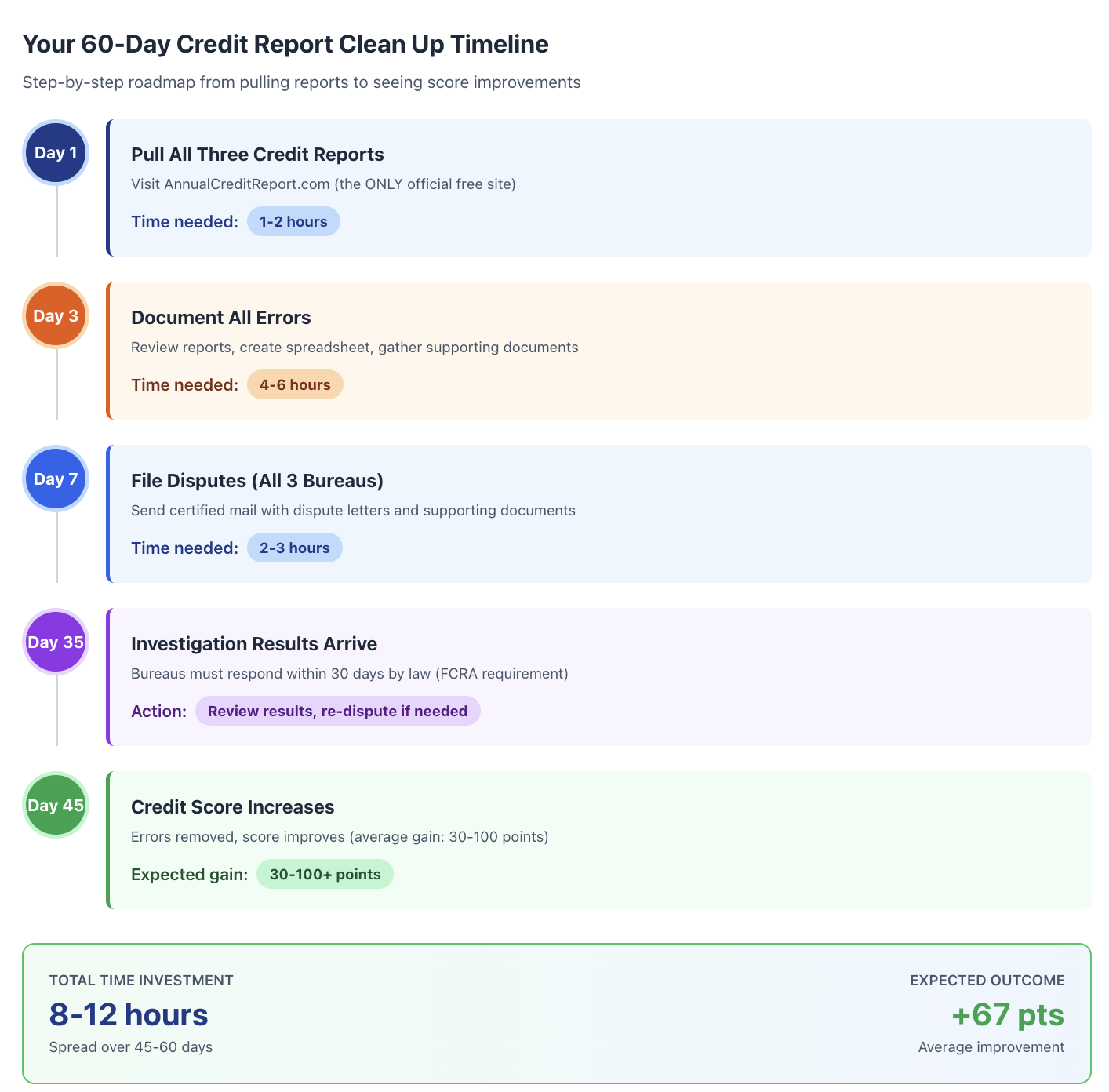
Sarah's credit report clean up timeline:
- Day 1: Pulled all three reports
- Day 3: Identified 4 errors (wrong late payment, duplicate collection, incorrect balance, outdated item)
- Day 5: Filed disputes with all three bureaus by certified mail
- Day 35: Received results, 3 of 4 items removed, 1 corrected
- Day 45: Credit score increased 67 points
- Day 60: Qualified for refinance she previously couldn't get
Common Credit Report Clean Up Mistakes
Avoid these errors that slow down or sabotage credit report clean up efforts:
Mistake 1: Only Checking One Credit Bureau
Each bureau may have different information. If you only check Experian, you'll miss errors on Equifax and TransUnion.
Fix: Always pull all three reports during credit report clean up.
Mistake 2: Disputing Too Many Items At Once
Filing 10-15 disputes simultaneously looks suspicious. Bureaus may label your disputes as "frivolous" and reject them all.
Fix: Start with 3-5 most impactful items. Once resolved, file additional disputes.
Mistake 3: Not Keeping Records
You need proof you filed disputes, what you claimed, and when you filed.
Fix: Keep copies of everything, dispute letters, supporting documents, certified mail receipts, bureau responses.
Mistake 4: Using Generic Dispute Templates
Credit bureaus recognize copy-pasted templates from credit repair websites. They often reject these automatically.
Fix: Write disputes in your own words with specific details about your situation.
Mistake 5: Giving Up After First Denial
Bureaus reject valid disputes all the time, especially on first attempt.
Fix: Re-dispute with more evidence. Escalate to CFPB if needed. Persist until resolved.
Mistake 6: Paying Collections Without Negotiation
Paying a collection doesn't remove it from your report. It updates to "paid collection", still negative.
Fix: Always negotiate "pay for delete" before paying any collection during credit report clean up.
Mistake 7: Disputing Accurate Information
If information is accurate and timely, disputing it won't work and wastes time.
Fix: Focus credit report clean up efforts on genuine errors. For accurate negatives, use goodwill letters or pay for delete.
When To Hire Help For Credit Report Clean Up
Most people can handle credit report clean up themselves. But some situations benefit from professional help:
Consider professional credit report clean up services if:
- You have 10+ errors across all three reports
- You're a victim of identity theft with multiple fraudulent accounts
- You need results quickly (mortgage application in 60 days)
- Bureaus keep rejecting valid disputes
- You lack time to manage the process
- Complex situations (bankruptcy, multiple collections)
Credit report clean up service options:
Nonprofit credit counseling: $0-50
- Basic dispute help
- Financial education
- Debt management plans
- Best for: Simple credit report clean up needs
Credit repair companies: $50-150/month
- Handle disputes for you
- Monitor results
- Ongoing support
- Best for: People who lack time or confidence
Consumer law attorneys: Contingency (no upfront cost)
- Legal action against bureaus violating FCRA
- Collect attorney fees from defendants if you win
- Best for: Serious FCRA violations
Warning about credit repair scams:
Avoid companies that:
- Guarantee specific results
- Charge large upfront fees
- Tell you to dispute everything
- Claim they can remove accurate information
- Suggest using a CPN (Credit Privacy Number), this is fraud
The Bottom Line on Credit Report Clean Up
Credit report clean up is the fastest, most effective way to improve your credit score if you have errors on your reports. Since 44% of Americans have at least one error, most people can benefit from thorough credit report clean up.
Your credit report clean up action plan:
- Pull all three credit reports from AnnualCreditReport.com today
- Review every section for errors (plan 3-4 hours)
- Document errors in a spreadsheet with supporting evidence
- File disputes by certified mail with all three bureaus
- Dispute directly with creditors who reported errors
- Follow up at 30 days if no response
- Re-dispute denials with additional evidence
- Negotiate "pay for delete" for collections
- Request goodwill deletions for isolated late payments
- Monitor results and track improvements
Expected results from credit report clean up:
- Errors removed: 30-60 days
- Credit score improvement: 30-90 days after removal
- Score increase: 20-100+ points depending on errors removed
Most important: Start your credit report clean up today. Every day errors remain on your report, they're costing you money through higher interest rates, insurance premiums, and denied opportunities.
Sarah waited 18 months before doing credit report clean up. In those 18 months, she paid $3,200 more in interest on her car loan due to a lower credit score caused by errors. When she finally cleaned up her credit report, her score jumped 67 points in 45 days.
Don't wait 18 months. Pull your reports right now and start your credit report clean up today.